
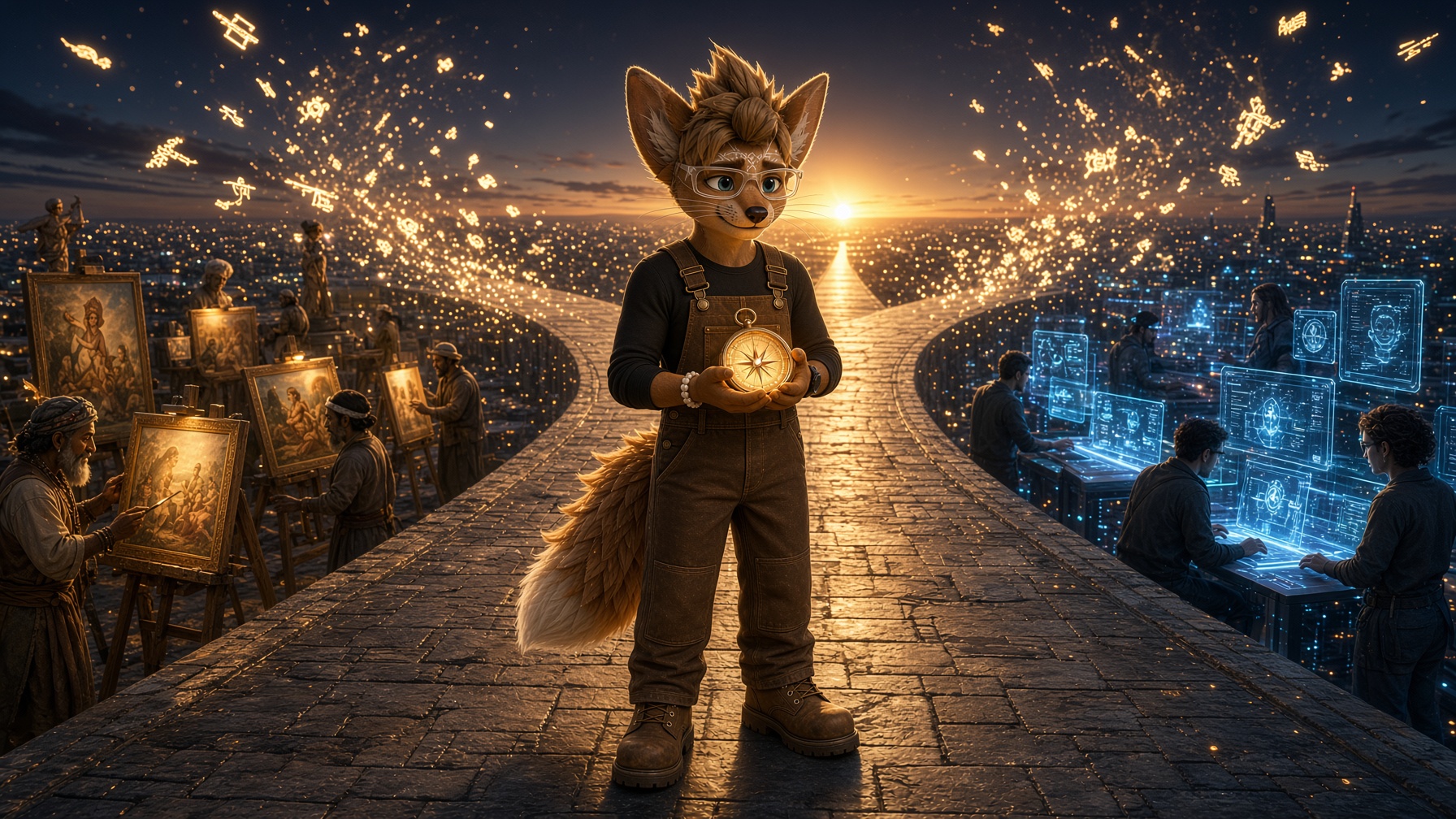
When a personal experience reaches more than a million people, the greatest challenge may not be facing criticism. It may be remaining faithful to the principles that made you speak in the first place.
I never expected my story to travel this far. What began as a personal account of my experiences commissioning artwork has become a conversation involving artists, customers, AI enthusiasts, critics, and people from different parts of the world. Some have come forward with stories remarkably similar to mine. Others have challenged my perspective, questioned my motives, or offered thoughtful arguments about the future of creativity. Somewhere along the way, I realized that the conversation had grown beyond anything I could have anticipated.
And with that realization came a responsibility I take seriously. I don't want my experiences to become an excuse for people to hate artists. I don't want my words turned into ammunition against an entire creative community. I don't want to manufacture resentment, encourage retaliation, or convince anyone that the failures of a few individuals should define the character of everyone who shares their profession.
I simply wanted to tell the truth about what happened to me.
When a Personal Story Becomes a Public Conversation
For years, I supported artists through commissions. I spent my own money, trusted people with my creative ideas, and developed relationships with individuals whose work I admired. Some of those experiences were wonderful. Others ended in disappointment, broken promises, and damaged relationships. Over time, those experiences influenced how I approached creativity and contributed to my growing use of artificial intelligence as a tool for bringing my ideas to life.
That decision was never a declaration of war against traditional artists. I didn't wake up one morning and decide that human creativity had become worthless. I didn't suddenly lose my appreciation for the skill, dedication, and imagination required to create something beautiful by hand. I simply discovered another way to continue doing something I loved, without depending entirely on someone else's availability, willingness, or reliability.
When I shared that experience publicly, I expected disagreement. Artificial intelligence is a deeply contentious subject in creative communities, and I understand why. People have legitimate concerns about their livelihoods, their work, and the direction technology is taking. Those concerns deserve to be discussed, even when I disagree with the conclusions people draw from them.
What I didn't expect was how many people would recognize themselves in my story.
One individual from China reached out and described spending thousands of dollars commissioning artists, building long-standing relationships with creators, and eventually experiencing conflicts that sounded strikingly similar to my own. We live in different parts of the world, speak different languages, and have never met. Yet we found ourselves describing remarkably similar experiences with trust, creativity, and disappointment.
That interaction meant something to me. Not because it proved I was right about everything, but because it reminded me that the people participating in this conversation are more than usernames and opposing arguments. They have histories, frustrations, relationships, and experiences that influence how they see the world.
I started this conversation hoping to be understood. I never imagined I might make a friend on the other side of the planet because of it.
Anger Is Not the Same Thing as Hatred
Some of the people defending me have been considerably more aggressive than I would choose to be. Their frustration is obvious, and in some cases, their language is sharp enough to make even me laugh. I don't believe it's my responsibility to police every emotional response someone has to a story that resonates with their own experiences.
People are allowed to be angry. They are allowed to criticize. They are allowed to describe how badly someone treated them, even when their words are uncomfortable to hear.
But I also recognize the difference between allowing someone to express their frustration and deliberately turning that frustration into a campaign against others.
I don't need to endorse every insult directed at my critics simply because the person delivering it happens to agree with me. I don't need to turn every disagreement into a confrontation, and I certainly don't need to reward hostility simply because it generates attention.
The same standard applies in the other direction. Someone who disagrees with my use of AI isn't automatically my enemy. Someone who questions my experiences isn't necessarily acting in bad faith. And someone who speaks passionately against technology may be responding to fears and experiences I haven't personally lived through.
None of that means I have to surrender my position. It means I can defend it without abandoning my standards.
The Artists Who Reminded Me Why Trust Still Matters
One of the most encouraging developments has been hearing from professional artists who understand exactly why these experiences are damaging.
Some have explained that meeting deadlines, communicating with customers, and delivering the work they promised are fundamental responsibilities. Others have acknowledged that unreliable creators can damage public confidence in commissioning, even when countless responsible artists continue doing excellent work every day.
Those voices deserve attention.
An artist who accepts someone's money and treats the resulting commitment seriously is demonstrating something worth celebrating. An artist who communicates honestly when something goes wrong is building trust. An artist who recognizes that a customer is a person with expectations, excitement, and limited resources is practicing professionalism.
These are the people I still want to support.
I refuse to allow my negative experiences to erase the contributions of good artists. Doing so would be unfair, and it would contradict the very principle that motivated me to speak about accountability in the first place.
If I believe individuals should be judged by their conduct, then I have to apply that principle consistently. I cannot criticize people for making sweeping assumptions about AI users while making equally sweeping assumptions about traditional artists.
That would make me guilty of the same behavior I object to.
Creative Freedom Is Not a Competition for Moral Superiority
I believe people should have the freedom to create.
For some, that means spending years mastering illustration, animation, sculpture, music, or traditional craftsmanship. For others, it means writing software, building virtual worlds, experimenting with generative tools, or combining technologies in ways that weren't possible a decade ago.
I have spent years building things myself. I know what it means to invest time, effort, and imagination into something simply because I want to see whether I can make it work. AI didn't invent that curiosity in me, and it didn't replace my desire to create. It gave me another set of tools to explore.
I don't believe the existence of those tools invalidates the work of traditional artists. Nor do I believe that respecting traditional artists requires me to abandon technologies that have become meaningful parts of my creative process.
These ideas can coexist.
We can discuss copyright, consent, compensation, and the economic consequences of technological change without treating every person who uses AI as morally defective. We can also discuss commission failures, customer experiences, and professional accountability without treating every artist as dishonest or unreliable.
Neither conversation benefits from reducing millions of individuals to caricatures.
And neither conversation requires us to stop listening.
I Am Not Trying to Lead a Movement
There is something strange about watching a personal story reach an enormous audience. The numbers become difficult to comprehend. People begin attaching broader meanings to your words. Some want you to become a symbol for their position. Others decide you represent everything they oppose.
But I am not interested in becoming either.
I am an individual who builds things, experiments with technology, supports creativity, and occasionally shares his experiences with the world. I have opinions, and I am willing to defend them. Sometimes I express those opinions sharply. Sometimes I show my teeth. I don't pretend to be endlessly agreeable, and I don't believe being a decent person requires becoming passive when someone treats you poorly.
But I also believe that having the ability to hurt someone with my words doesn't automatically give me a good reason to do it.
The attention surrounding this conversation has not changed that.
I don't need to manufacture enemies to keep an audience interested. I don't need to escalate a conflict because confrontation attracts engagement. I don't need to pretend that every person defending me is correct, or that every person criticizing me is wrong.
Most importantly, I don't want popularity to become a substitute for judgment.
If the audience disappeared tomorrow, I would still want to believe the things I am saying today.
The Standard I Have to Live With
There is a question I keep coming back to as this conversation continues: Am I doing right by my own standards?
Not whether I am winning. Not whether my critics are losing. Not whether a post performs well or whether another thousand people decide to follow me.
Am I being truthful? Am I treating people fairly? Am I recognizing the good alongside the bad? Am I allowing others the same freedom of expression that I expect for myself? Am I willing to acknowledge when I get something wrong?
Those questions matter more to me than any argument on the internet.
I cannot control what every person does with my story. Some will use it to reinforce beliefs they already hold. Others will misunderstand it, criticize it, or reshape it into something I never intended. Some will find comfort in knowing they aren't alone. Others may discover an opportunity to reconsider how they treat the people who support their work.
What I can control is what I choose to contribute.
I can tell the truth without embellishing it. I can defend my freedom without denying someone else's. I can recognize the pain behind another person's anger without making their anger my identity. And I can continue supporting the people who demonstrate the honesty, care, and professionalism I believe every creative relationship deserves.
I don't know where this conversation will go next. I never imagined it would travel this far in the first place.
But if it leads to even a few people understanding one another better, if it encourages a customer to speak honestly about a difficult experience, or inspires an artist to take another look at the trust someone places in their hands, then something constructive may come from all of this.
I don't need the world to agree with me.
I don't need to be its hero, its villain, or the leader of its next great argument.
I just want to be able to look back at what I said, how I treated people, and the choices I made, and recognize myself in all of it.
Because at the end of the day, the only person whose standards I am obligated to live by are my own.
Comments